

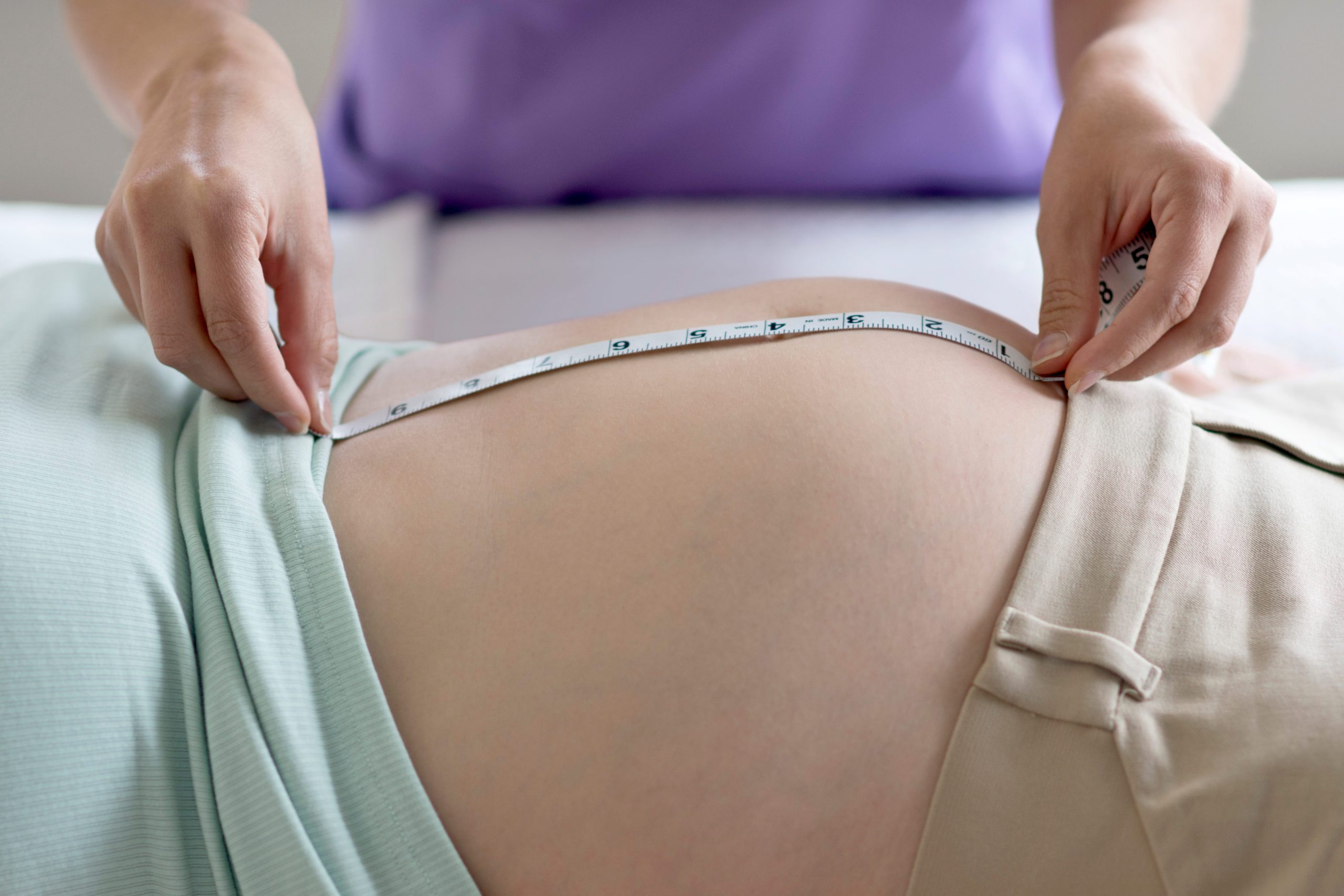

GWINNETT COUNTY, Ga. — In a midwife’s suburban Atlanta dwelling with a playground and hen coop outdoors, Madie Collins lay on an examination desk whereas the midwife measured her pregnant stomach. Not like at many a health care provider’s workplace, no crinkly paper sheet lined the desk and no antiseptic chill lingered within the air. The room subsequent door, the place Collins’ appointment started, was full of kids’s toys and scented candles and warmed by a wood-burning range.
The licensed skilled midwife pressed the button on a handheld Doppler ultrasound machine she positioned on Collins’ stomach. “That’s her heartbeat,” she mentioned to Collins’ 3-year-old daughter, who sat beside her mother as a whooshing sound stuffed the room. “I feel Mommy’s child’s proper right here.”
The midwife isn’t licensed as a nurse. In Georgia, that makes what she’s doing unlawful. KFF Well being Information agreed to not establish her by identify.
Georgia is certainly one of seven states the place delivering infants can earn non-nurse midwives, at minimal, a cease-and-desist letter requiring them to finish their careers. In North Carolina, it’s a misdemeanor. In New York, it’s a felony.
In the meantime, demand for his or her companies is rising. Meant dwelling births rose by 42% nationally from 2020 to 2024, based on the Nationwide Middle for Well being Statistics, and people births are sometimes overseen by licensed skilled midwives. In Georgia, they rose by 72%. Midwives who help with dwelling births usually see purchasers from prenatal appointments by means of several visits after childbirth, offering extra postpartum checkups than most new moms obtain.
Dwelling births make up 1.5% of deliveries nationwide. Within the eight states the place they had been commonest in 2024 — Hawai‘i, Idaho, Montana, Pennsylvania, Utah, Vermont, Wisconsin, and Wyoming— they made up 3-5% of births.
As that quantity rises, midwifery advocates mentioned, regulating the observe with licenses would permit dwelling births to be safer. Free delivery — with out the assistance of a talented skilled earlier than or after labor — will be dangerous for mothers and babies.
“Individuals are going to maintain having their infants at dwelling, and so they deserve a skilled supplier,” mentioned Missi Burgess, president of the Georgia chapter of the Nationwide Affiliation of Licensed Skilled Midwives.
For many years, skilled midwives have been advocating for legal guidelines to legalize and regulate their occupation. Extra lawmakers have supported these efforts previously 15 years, with 36 states and Washington, D.C., permitting them to get licensed to ship infants. Final yr, a wave of state lawmakers — in Georgia, Mississippi, Nebraska, New York, North Carolina, Ohio, and West Virginia — tried so as to add their states to the listing, though none of their payments has develop into regulation.
Licensed skilled midwives ship infants in houses or delivery facilities. Fairly than attend nursing faculty — which many can’t afford — they earn a nationally acknowledged certificates by attending not less than 55 births and demonstrating their data. Nurse-midwives extra usually ship infants in hospitals or clinics than in sufferers’ houses.
Some hospitals and medical doctors oppose midwife licensing proposals with out sure guardrails. The American School of Obstetricians and Gynecologists cites studies displaying that infants are twice as more likely to die throughout deliberate births at dwelling or in delivery facilities as in hospitals, whereas acknowledging that the info stays restricted. It doesn’t account for a number of components, together with who assisted within the delivery.
Nonetheless, distinguished tales of dwelling births with midwives gone fallacious contribute to the skepticism round licensing legal guidelines. In 2023, The Washington Submit published an investigation of a licensed midwife who pleaded responsible to felonies in Virginia after an toddler dying and assisted with dwelling births in Maryland through which two extra infants died.
In Mississippi, a invoice that will have regulated and licensed skilled midwives died after a state senator blocked a vote within the committee he chaired. Democratic Sen. Hob Bryan told Mississippi Today he didn’t “want to encourage that exercise.”
However midwives mentioned they’ve a sympathetic ear now within the Trump administration, with its Make America Wholesome Once more motion. Cassaundra Jah, government director of the National Association of Certified Professional Midwives, mentioned she has been on calls with midwifery teams pushing for the Division of Well being and Human Providers to offer authorized protections for them, and a few midwives have been involved with the company.
HHS spokesperson Emily Hilliard declined to touch upon coverage proposals however instructed KFF Well being Information that the administration “recurrently meets with a variety of stakeholders to listen to enter from the American public.”

Hospitals Need Guardrails
Advocates for the license say permitting licensed skilled midwives to offer care would assist deal with a scarcity of maternity care suppliers.
“Some midwives are leaving our state,” Rep. Karen Mathiak, a chiropractor who sponsored the Georgia invoice, mentioned throughout a listening to on the measure final yr. “They’re being pressured to give up. And now we now have a scarcity of those suppliers to deal with our pregnant mothers.”
A 2024 report by the March of Dimes discovered that 35% of counties within the U.S. haven’t any birthing facility or obstetric supplier. Georgia has the Thirteenth-highest maternal mortality price within the nation, based on the March of Dimes.
After the U.S. Supreme Court docket’s reversal of Roe v. Wade in 2022 eradicated federal safety for abortion, six-week abortion bans prompted extra suppliers to go away states corresponding to Georgia and Texas. Idaho misplaced a third of its OB-GYNs by December 2024, two years after its abortion ban took impact. Docs who left states with such legal guidelines cited concern of prosecution and an lack of ability to offer the usual of care.
Of the 13 states with the fewest maternity care suppliers per capita, 9 had a full or six-week abortion ban as of 2024, The Commonwealth Fund found.
Licensing midwives gained’t resolve the bigger maternity care scarcity, but it surely’s a primary step, mentioned Saraswathi Vedam, a professor of midwifery and the principal investigator on the Delivery Place Lab on the College of British Columbia. Licensed skilled midwives presently attend solely about 1.4% of births within the U.S., based on federal information.
The Georgia bill would have granted licensed skilled midwives licenses by means of a state board, allowed them to manage lifesaving drugs, and required their companies to be lined by personal insurance coverage and Medicaid. They’d not have wanted a doctor to oversee them. With out that mandate, giving delivery outdoors of a hospital might be an choice for extra folks.
However the Georgia Division of Public Well being and the Georgia Hospital Affiliation opposed the licensing invoice, primarily as a result of they needed extra rules than the midwives had been prepared to just accept — together with doctor supervision.
Anna Adams, a spokesperson for the hospital affiliation, recommended establishing switch agreements that required all ladies planning to have a house delivery to register on the hospital first. When a laboring girl is transferred to a hospital, which occurs in about 11% of planned home births, “we now have no prior data of this affected person,” Adams mentioned. “It’s a difficult state of affairs to inherit once you’re making an attempt to avoid wasting the mom and the child with none background.”
Georgia midwives mentioned they deliberate to deliver the licensing proposal again subsequent yr.
In early April, three midwives sued Georgia for limiting their means to observe, arguing that the foundations violate the state structure.
“Each pregnant particular person ought to be capable of select the place they provide delivery and with whom,” mentioned Jamarah Amani, a plaintiff within the lawsuit and co-founder of the National Black Midwives Alliance.
Black ladies are 3 times as more likely to die throughout or after childbirth as white pregnant sufferers. In January, a distinguished Black nurse-midwife in South Carolina died after surprising problems from childbirth.
Right this moment, midwives and their purchasers are predominantly white, however the dwelling delivery price amongst Black ladies rose 42% nationally from 2019 to 2024, based on the Facilities for Illness Management and Prevention.
“In the end the system has failed us as a folks,” mentioned Tina Braimah, a Black nurse-midwife who attended dwelling births for a decade. She then opened a birth center in North Carolina, permitting her to see extra purchasers from a wide range of backgrounds. “When the system persistently fails you, you search for different choices.”
Changing into A part of the System
Many maternal well being researchers say moms fare higher when midwives are a key a part of the well being system. In 2018, researchers on the Delivery Place Lab revealed a research of all 50 states displaying that integrating midwives was related to higher outcomes for mothers and infants, together with decrease charges of toddler deaths. Integration entails collaboration amongst all types of midwives and medical doctors in order that sufferers can simply switch to or from a hospital. It additionally entails giving all midwives the authority to observe the total vary of their expertise, together with prescribing lifesaving remedy.
A 2020 report by the Nationwide Academies of Sciences, Engineering, and Medication states that information from different international locations suggests dwelling births will be as secure as hospital births for low-risk ladies who’re a part of an built-in, regulated system.
Washington state has one of many highest charges of midwife integration within the U.S., based on the Birth Place Lab. Its dwelling delivery price is persistently larger than the nationwide price, whereas its infant mortality rate stays decrease than the nationwide common.
One in 5 ladies report being mistreated throughout maternity care, based on a 2023 CDC survey. Pregnant sufferers are usually extra glad when midwives lead their care, whether or not at a hospital, a delivery heart, or dwelling.
Hannah Haynes gave delivery to her first three kids in a hospital close to her dwelling in Jefferson, Georgia. In the course of the third labor, which was induced, she obtained a catheter that led to a urinary tract an infection after which sepsis, a life-threatening situation. She was separated from her new child for 4 days whereas receiving therapy.
“One thing has to alter,” Haynes mentioned.
Haynes regrets electing to get induced when it wasn’t medically essential. She gave delivery to her fourth little one at dwelling, with the assistance of a licensed skilled midwife she trusted. She’s pregnant together with her fifth and plans to make use of the identical midwife. She mentioned she gained’t ship at a hospital once more.
“I used to be a bit nervous,” Haynes mentioned, as a result of she had heard rumors that midwives didn’t know what they had been doing. However after assembly the midwife, “I simply felt so assured in her.”