



You’d have a tough time discovering any critical endurance athlete in 2025 who thinks protein doesn’t matter. Gone are the carb-centric days of pasta and Gatorade and nothing else. However determining how a lot protein runners, cyclists, and different endurance junkies really want—and once they want it—stays a piece in progress.
I’ve grappled with these questions a couple of occasions not too long ago—in a chunk busting some common protein myths, and in one other discussing the concept of maximum protein consumption. However now a new review paper in Sports activities Drugs, from a analysis workforce led by Oliver Witard of King’s Faculty London, affords a complete overview of the present state of information. Witard and his colleagues give attention to two key questions. First, how a lot protein do endurance athletes want every day to remain wholesome and optimize long-term coaching variations? And second, what position can the tactical use of protein play in dashing up short-term restoration and boosting efficiency?
Protein for the Lengthy Time period
Authorities pointers at present suggest getting no less than 0.8 grams of protein per kilogram of physique weight (g/kg) every day. For somebody who weighs 150 kilos, that works out to 55 grams of protein. For reference, a typical 5-ounce can of tuna has about 20 grams of protein.
There are two primary issues with this guideline, nonetheless. First, it’s supposed to be the minimal required to remain wholesome, not the optimum quantity to maximise efficiency. Second, it was formulated utilizing a measurement approach that includes monitoring the quantity of nitrogen being consumed and excreted from the physique, which some scientists imagine underestimates protein wants. A more moderen strategy known as the “indicator amino acid oxidation method,” which includes labeling one particular kind of amino acid with a carbon isotope to see how rapidly it’s burned, provides larger numbers and can also be extra sensible for testing particular populations like athletes.
The standard argument for getting a lot of protein is that it gives the constructing blocks—amino acids—for constructing new muscle. That’s vital for power coaching, however endurance athletes want it for different causes. One is that these constructing blocks are used to restore the muscle injury incurred by arduous coaching: the longer and tougher you run, the extra injury you incur, and extra protein you presumably want for repairs.
Throughout extended train, your physique additionally begins burning amino acids for gas. The quantities are usually small, and the way a lot you burn relies on the character of the train and what else you’re consuming, however in some circumstances 5 to 10 % of the gas you want for a given exercise is supplied by protein. Should you’re coaching arduous, you’ll must eat further protein to exchange these losses.
There are some extra refined prospects, too. Muscle isn’t the one a part of the physique that’s constructed from protein. One of many key variations athletes achieve from endurance coaching is a rise within the quantity of protein within the mitochondria, the place mobile power is generated. The extra protein within the mitochondria, the extra effectively it creates power. A number of research have sought to work out whether or not consuming extra protein boosts the mitochondrial response to train. The outcomes to this point haven’t been convincing, but it surely’s nonetheless an open query.
Witard and his colleagues pooled knowledge from numerous indicator amino acid research to evaluate protein wants for endurance athletes beneath numerous circumstances. Listed below are a number of the key numbers:
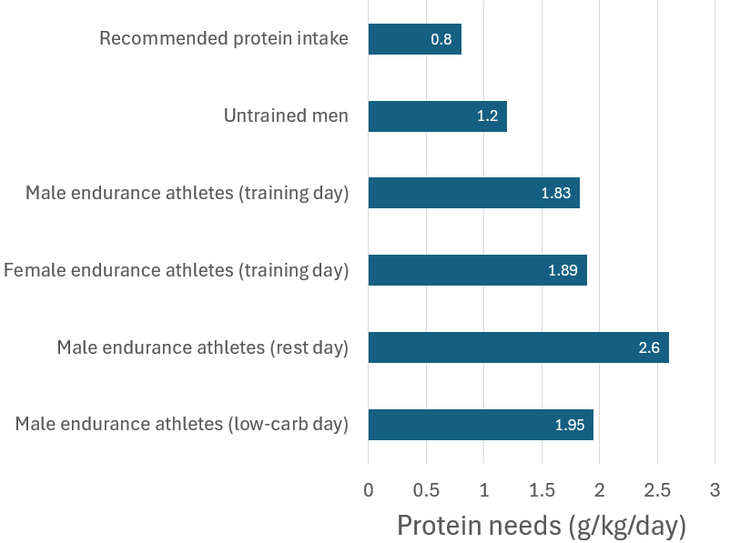
The indicator amino acid knowledge means that even untrained folks want about 1.2 g/kg of protein per day, 50 % greater than the FDA’s beneficial each day consumption of 0.8 g/kg. And endurance athletes want one other 50 % greater than untrained folks, with a stage of 1.8 g/okay/g guaranteeing that 95 % of individuals are getting all of the protein their our bodies can use. As compared, studies utilizing the identical indicator amino acid methodology discover that resistance-trained athletes want someplace between 1.5 and a couple of.0 g/kg per day, elevating the chance that endurance athletes would possibly really want extra protein than lifters.
There’s an vital level to remember, although: endurance athletes additionally are likely to eat much more than the typical particular person, which implies they mechanically get extra protein. Current protein intake amongst American adults averages 1.25 g/kg for males and 1.09 g/kg for ladies, fairly near the general goal of 1.2 g/kg for untrained folks. As compared, one study discovered that endurance athletes common 1.4 to 1.5 g/kg—not fairly on the 1.8 g/kg stage, however not that distant.
There are another nuances in that graph. Knowledge on male-female variations may be very sparse, however there are some hints that girls would possibly require greater than males relative to their physique weight. That is perhaps notably true through the luteal part of the menstrual cycle, since progesterone can have an effect on protein burning. Witard and his colleagues make a blanket suggestion that each female and male endurance athletes ought to goal for 1.8 g/kg, however they throw within the speculative risk that females “might take into account” upping it to 1.9 g/kg through the luteal part of their cycle.
Quick-Time period Protein Ways
The large shock within the knowledge above is that endurance athletes appear to make use of extra protein on their relaxation days than on coaching days. This discovering has popped up in a few studies, and it’s undoubtedly not what the scientists have been anticipating. It’s doable that there’s some quirk of metabolism that’s skewing the measurements used to evaluate protein wants whenever you attempt to examine train and non-exercise days.
But it surely’s additionally doable that the impact is actual—that whenever you give your physique a break, its restore and adaptation mechanisms kick into overdrive and thus use extra protein than traditional. If that is true, it’s an argument for upping your protein consumption on relaxation days: Witard and co. recommend aiming for two.0 g/kg. And on a extra elementary stage, it’s an argument for together with true relaxation days in your coaching program periodically, since they appear to set off restoration processes that don’t occur on regular coaching days. At this level, I’d say the jury remains to be out on whether or not the impact is actual.
Both means, the researchers recommend aiming for 0.5 g/kg of protein following train to assist restore any muscle injury incurred through the exercise. For a 150-pound particular person, that’s 34 grams of protein, which is what you’d get in a considerable meal with a superb protein supply. How quickly is “after train”? I don’t suppose there’s any convincing knowledge that claims it must be instantly after. Your subsequent meal is ok—until your exercise was after dinner and also you’re planning to move to mattress, wherein case you must make a particular effort to get some protein in.
The info additionally means that athletes use extra protein once they’re coaching in a carbohydrate-depleted state. On this case, we’re not speaking a couple of persistently low-carb weight-reduction plan, however moderately doing sure coaching classes in a low-carb state to assist the physique adapt to burning fats extra effectively. There’s first rate proof that protein might help energy these exercises, and Witard suggests taking in 10 to twenty grams of protein earlier than and/or throughout this sort of session.
This concept of utilizing protein to compensate for low carbs additionally connects to one of the hotly debated concepts about protein for endurance athletes. There have been numerous research-backed claims through the years that including protein to a sports activities drink that you simply devour throughout a race or coaching session will improve your efficiency, and that taking in some protein within the instant post-workout window will velocity up the speed at which you refill the carbohydrate shops in your muscle mass.
All these claims, Witard and his colleagues argue, are the results of research the place the themes didn’t get sufficient carbohydrates. Should you’re meeting your carb needs, including protein to a sports activities drink will neither enhance your efficiency nor speed up your muscle refueling. There could also be exceptions for ultra-endurance occasions, which haven’t been well-studied and have considerably totally different metabolic challenges in comparison with a marathon. However the researchers’ remaining conclusion is a reminder that for endurance athletes, regardless of protein’s present reputation, carbohydrate remains to be king.
For extra Sweat Science, be a part of me on Threads and Facebook, join the email newsletter, and take a look at my new ebook The Explorer’s Gene: Why We Seek Big Challenges, New Flavors, and the Blank Spots on the Map.